.jpg)


SAT vs. ACT in 2026: Why the Choice Suddenly Matters Again

For a few years, the question of SAT vs ACT barely mattered to a lot of families. Test-optional policies meant thousands of applicants skipped both exams entirely and still got into strong universities. That window is closing fast. A growing list of selective schools, including every Ivy League university, now requires or strongly recommends test scores again, and the exams themselves are not the ones parents remember either. If you are a student or parent starting to look into SAT coaching in Dubai this year, you are arriving at a different testing landscape than the one that existed even three years ago. This guide covers what changed, which schools now require scores, how the current SAT and ACT compare, and how to decide between them.

Why the Test-Optional Era Is Ending
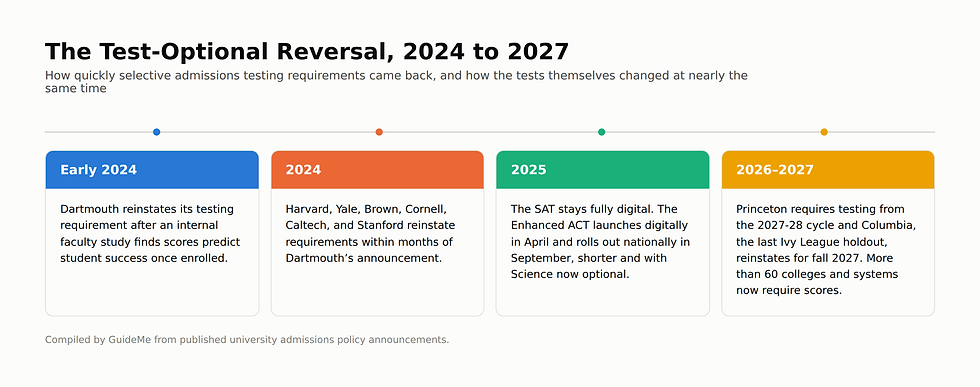
During the years when most colleges made testing optional, many families reasonably assumed the SAT and ACT were becoming less relevant. That assumption no longer holds. Starting with Dartmouth College in early 2024, a wave of highly selective universities began reversing course after internal research suggested that test scores remained one of the strongest predictors of how a student would perform once enrolled.
Within months of Dartmouth's announcement, Harvard, Yale, Brown, Cornell, Caltech, and Stanford all reinstated testing requirements. Princeton followed in October 2025 for the 2027-28 admissions cycle, and Columbia, the last Ivy League holdout, reinstated its requirement for fall 2027. Every Ivy League university now requires or strongly recommends test scores.
The reversal is not limited to the Ivy League. More than 60 colleges and university systems have reinstated testing requirements, including:
● Louisiana State University and Auburn University
● The University of Florida and the University of Georgia System
● The University of Texas at Austin
● The University of Alabama and the University of North Carolina at Chapel Hill, for applicants below a set GPA threshold
For a student who started high school assuming testing might not matter, this shift changes the calculation. Skipping SAT or ACT prep is no longer a safe default for anyone applying to a selective university.
This pace of reversal has caught plenty of families off guard, including many in Dubai's international school community who assumed the test-optional years would last through their child's application cycle. Counselors who work in SAT coaching in Dubai report a noticeable jump in enrollment from students who had planned to apply without scores at all.
The Tests Themselves Have Changed Too
Even for families who remember the SAT and ACT well, the current versions are not the same exams. Both went through an overhaul in the last two years, around the same time testing requirements started coming back.
The SAT moved to a fully digital, adaptive format in 2024. The paper SAT is gone everywhere it has rolled out, and the new digital version is shorter, uses a built-in calculator throughout the math section, and adjusts difficulty between the two modules of each section based on how a student performs on the first one.
The ACT followed with its own overhaul. The Enhanced ACT launched digitally in April 2025 and rolled out nationally in both digital and paper form starting September 2025. It cut the core test from 215 questions to 131, made the Science section optional rather than required, and kept the familiar 1 to 36 composite scale.
In other words, a parent who took either test years ago, or a student who only heard about the old format, is not getting an accurate picture from outdated advice. Current preparation needs to be built around the tests as they exist now, not as they used to be. Even test-prep programs need to keep pace: SAT coaching in Dubai that still leans on retired practice material is teaching students to manage a test they will not sit for.
SAT vs ACT in 2026: The Comparison Table
Both tests measure similar academic skills, but the format, timing, and cost differ enough to matter for planning. Here is how the current versions compare directly.
Feature | SAT (Digital) | ACT (Enhanced) |
Format | Fully digital, module-level adaptive | Digital or paper |
Total duration | 2 hours 14 minutes, plus a break | About 2 hours 5 minutes core; 2 hours 45 minutes with Science |
Sections | Reading and Writing, Math | English, Math, Reading, optional Science |
Total questions | 98 | 131 core |
Scoring scale | 400 to 1600 | 1 to 36 composite |
Calculator | Built-in, available throughout Math | Built-in on digital; approved calculators on paper |
Science section | Not included | Optional; about 90 percent of tracked colleges do not require it |
Superscoring | Common among colleges that accept it | Actively supported by ACT |
Domestic fee | 68 dollars | 68 to 97 dollars, depending on sections |
International fee (Dubai and outside the US) | Around 111 dollars | 186.50 to 211.50 dollars |
Quick take, at a glance
● The SAT is shorter overall and keeps a calculator on hand for every math question.
● The ACT gives you more control over the Science section, since it is optional at most colleges now.
● Internationally, the SAT costs noticeably less to register for than the ACT.
● Neither scale means much without context: check your target schools' current middle 50 percent range for whichever test you take.

Which Colleges Require Testing in 2026 and 2027
School or system | Testing policy | Effective cycle |
Dartmouth, Harvard, Yale, Brown, Cornell, Caltech, Stanford | Required | Already in effect |
Princeton | Required | 2027-28 cycle |
Columbia | Required | Fall 2027 |
UT Austin, University of Florida, University of Georgia System, LSU, Auburn | Required | Already in effect |
University of Alabama, UNC Chapel Hill | Required below a set GPA threshold | Already in effect |
Policies can differ by program within the same university, and several state systems apply GPA-based thresholds rather than a blanket rule, so the safest step is always checking a specific school's admissions page directly rather than relying on a list, even a current one. Many families researching SAT coaching in Dubai start exactly here, by confirming which of their target schools require a score before deciding how much prep time to invest.
For families also applying to universities in the United Kingdom, Canada, or elsewhere, this shift matters mainly for US-bound applications. Most UK and Canadian universities do not require the SAT or ACT at all, so the right move is to map testing requirements against your actual list of target schools rather than assuming one rule applies everywhere you apply.
Which Test Should You Take?
If you... | Consider... |
Prefer a shorter overall test day and want a calculator on every math question | SAT |
Want the option to skip Science and are stronger in reading-heavy sections | ACT, since Science is optional at most schools |
Are strong at data and graph interpretation and want that reflected in your score | ACT with Science included |
Are applying to schools where your target programs lean toward one test in their published data | Check that school's data directly before deciding |
Want to keep costs down as an international test taker | SAT, based on current international fees |
How to Decide: A Step-by-Step Approach
Once you understand what changed, deciding which test to prepare for comes down to a short, structured process, the same one used in most SAT coaching in Dubai consultations:
● Take one official full-length practice test for each exam under real timed conditions before choosing either one.
● Compare percentile ranks, not raw scores, since the 1 to 36 and 400 to 1600 scales are not directly comparable.
● Check the current middle 50 percent test range published by each target school, not last year's number, since requirements and typical scores are shifting quickly.
● Decide early whether Science matters to your profile, since it is optional at most schools now but still required or recommended at some.
● Confirm whether your target schools superscore, since that can change how many times it makes sense to sit for a test.
● Build in time for a retake. Both tests are new enough that first-attempt scores often undersell a student's real ability.
When to Bring In SAT Coaching in Dubai
Self-study can work well for students who are strong independent learners and have enough runway before application deadlines. But because both tests changed formats so recently, a lot of free practice material, and even some paid resources online, is still built around the retired versions, which can waste real study time without a student realizing it.
This is where SAT coaching in Dubai support tends to make the biggest difference: a program built around the current digital SAT and Enhanced ACT, rather than outdated material, plus regular practice tests that show which exam suits a student better. At GuideMe, our instructors come from top-ranked universities, and our students see an average improvement of 200 to 250 points on the SAT with structured preparation. We have helped more than 500 students gain admission to schools including Harvard, Stanford, Berkeley, and Cambridge. If you want a clearer sense of which test fits your goals, you are welcome to book a free consultation with our team.
Building a Prep Timeline Around the New Tests
The right timeline depends on your grade level and how far off your application deadlines are, but the shape of a sensible plan looks similar across profiles.
● 9th and 10th grade: no need to commit to either test yet. Focus on reading habits and math fundamentals, since both exams reward accumulated skill more than test-specific tricks.
● 11th grade: take one official practice SAT and one official practice ACT in the fall, then commit to one test and begin structured prep by winter.
● Summer before 12th grade: aim for a first real attempt by early fall of senior year, leaving room for one retake before the earliest application deadlines.
● Applying test-optional: even at schools that remain test-optional, a strong score can still help an application, so skipping prep entirely is a riskier bet than it was a few years ago.
Conclusion
The SAT and ACT matter again for a simple reason: a large and growing number of selective colleges now require scores that were optional only a few years ago, and both tests changed enough in the meantime that old advice does not fully apply. Digital SAT modules and the Enhanced ACT's shorter, science-optional format are the tests students are sitting for in 2026, not the ones their older siblings or parents remember. Comparing the two on format, cost, and how they weigh against your target schools' current policies, rather than reputation alone, is what determines which one fits. Whether you build a plan on your own or with support from SAT coaching in Dubai, deciding early and preparing for the current version of the test is what protects an application timeline that is already tighter than it used to be.
FAQs
Do I need to take both the SAT and ACT?
No, most students only need one. Colleges accept either test and do not favor one over the other, with the exception of a handful of programs that state a preference, which is worth checking directly.
Is the old paper SAT still offered anywhere?
No, the SAT has moved to a fully digital format everywhere it is administered, including test centers across Dubai and the wider UAE.
Is Science required on the ACT now?
Not at most colleges. Around 90 percent of tracked schools have made the ACT Science section optional, though a small number still require or recommend it, so check your specific target list.
What if my target schools are still test-optional?
A strong score can still strengthen an application even where testing is optional, particularly for competitive programs or scholarship consideration, so skipping prep entirely is riskier than it was a few years ago.
How many times should I plan to take the test?
Most students benefit from one solid attempt after real preparation, plus a buffer for one retake if the first score does not reflect their practice test results.
Can colleges combine my best section scores across attempts?
Many colleges that accept the ACT support superscoring, and a number that accept the SAT do as well, though policies vary by school and are worth confirming directly.
How much does it cost to take these tests from Dubai?
The SAT runs about 111 dollars internationally, while the ACT ranges from about 186.50 to 211.50 dollars internationally depending on whether you add the optional Writing section.
Does a strong test score matter as much as GPA?
Both carry real weight at most selective schools. Admissions committees generally look at test scores alongside GPA and coursework rigor rather than ranking one above the other, so a strong record in both remains the safest position.


For anyone researching 10.00.1, this is a useful place to start. The content explains common IP address searches without using overly complicated terms. Check this helpful guide if you want basic information in an easy-to-read format.